Science Journalism

Forcing the fate of filaments

What’s he building in there?

the Fulcrum
Published: Sept 4

YOUR BODY IS made of trillions and trillions of cells of different types. Each cell knows its type, but what determines the type of cell that each becomes? How did your liver cells know to specialize into a liver or your brain cells to become neurons?

The researcher

Andrew Pelling, the Canada research chair in experimental cell mechanics at the University of Ottawa, does research on the interface between molecular biology, physics, and engineering. He’s interested in the dynamic mechanical properties of cells and how they control cell differentiation and tissue formation.

On top of running a multidisciplinary laboratory in the physics and biology departments, Pelling partakes in bioart and engages in social media. One of his ongoing projects is an artificial tissue sample that automatically tweets its growth to the twitterverse.

The project

Pelling wants to know how a cell’s fate is set. In particular, he is interested in how external geometry and forces can signal strong cues that determine how a stem cell differentiates or that encourage a specialized cell to change its behaviour.

Pelling pulls, stretches, and pokes individual living cells. One way he manages this mechanical manipulation on such tiny life forms is by retrofitting an atomic force microscope into a tiny prong for poking and pulling. This way, he can apply very controlled forces onto specific spots on cells, such as their nuclei.

The key

Pelling poked the nucleus of various cells and watched the response. He observed that immediately after the poke, the long filaments that run from the nucleus to all corners of the cell (forming the cytoskeleton and giving shape and rigidity to the cell) would quickly deform in response to the force on the nucleus, rather than reacting directly to the force of the tiny prong pushing down on the cell.

Much more slowly, the entire cytoskeleton would reorganize itself by retracting the filaments from the edges of the cell and then relaxing into a new structure. Instead of occurring equally throughout the cell, however, restructuring occurred in only one or two locations.

Restructuring its cytoskeleton is just one way that a cell can respond to stress. In fact, Pelling has been looking at many other environmental cues, like stretching the surface that a cell is living on or placing cells in confining geometries. Cells dynamically respond to a complicated set of environmental signals that ultimately determine their fate.
Slip-FFF with Super-Hydrophobic Surfaces

The flexibility of FFF stems from the large set of transverse external fields that can be used. Gravitational fields, centrifugation, electrical fields, magnetic fields, dielectrophoretic fields, acoustic fields, photophoretic fields, cross-flows (both symmetrical and asymmetrical) and thermal gradients have all been used to generate non-uniform solute concentration distributions.

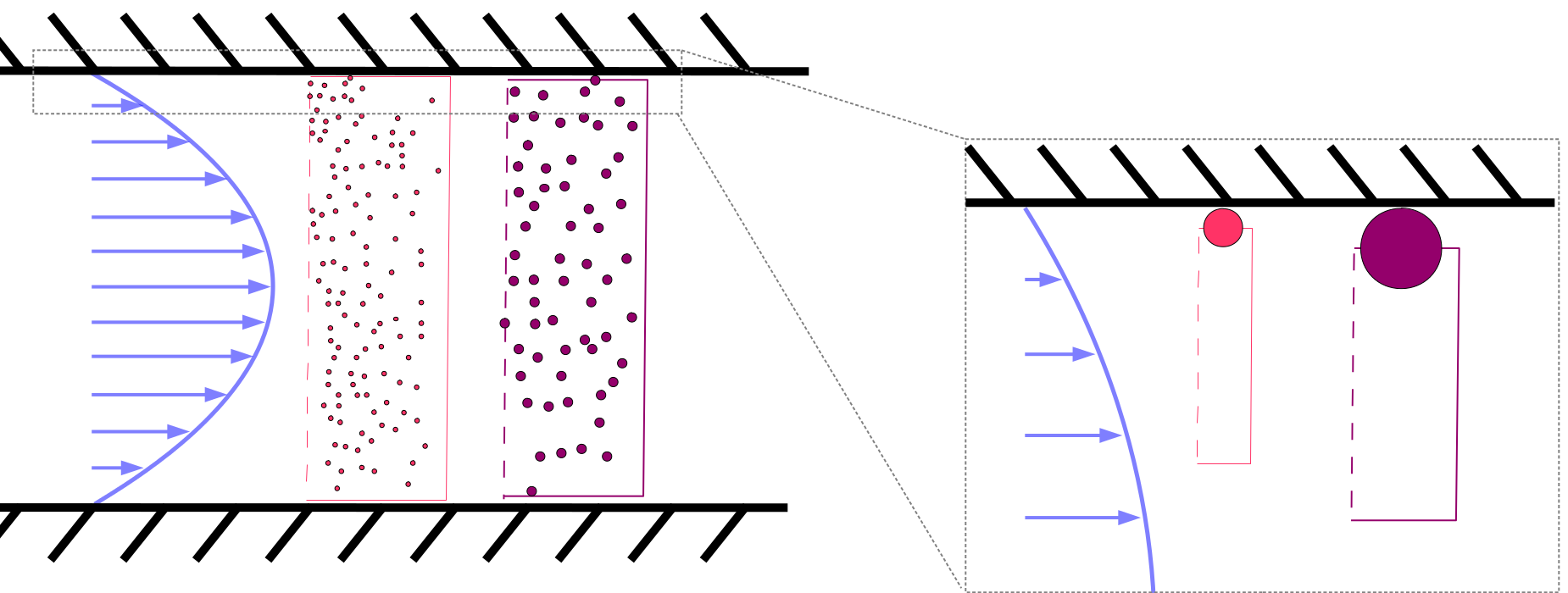
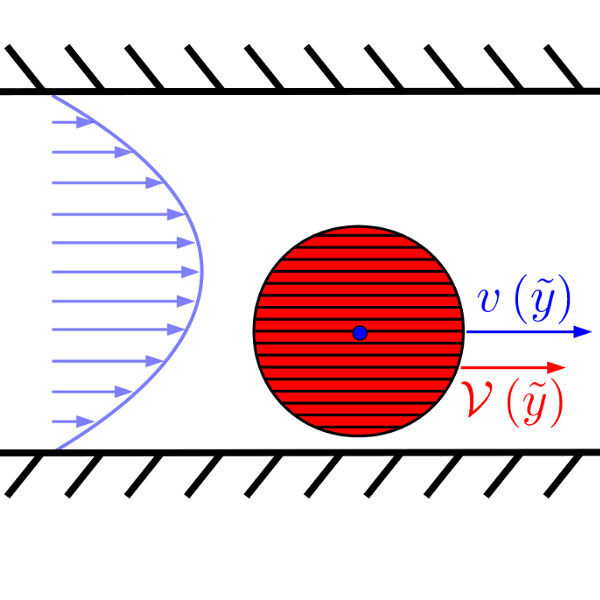
But FFF also depends on a non-uniform flow profile. It is generally taken for granted that the profile in a channel obeys Poiseuille flow. By changing the flow profile we may change the retention ratio (the mean velocity of the solutes normalized by the mean fluid flow).

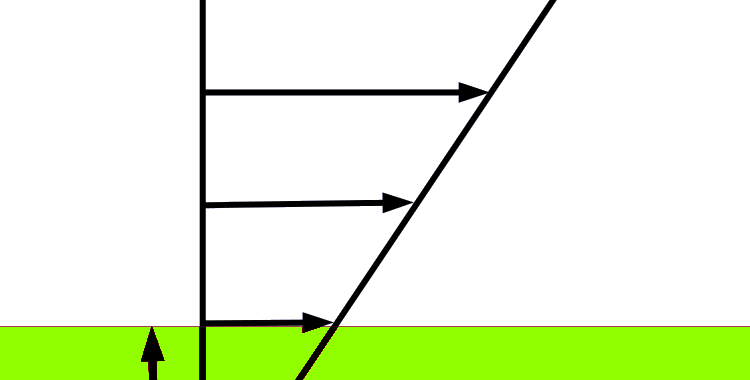
One way to alter the flow profile is to have a slip wall. Usually, fluids flowing over a solid surface obey a no-slip boundary condition, meaning that the speed goes to zero. However, modern nanoengineering can construct ultrahydrophobic surfaces by nanopatterning structures on the surface that reduce the drag on the fluid.

Another idea is to superimpose Poiseuille flow and electroosmotic flow with a thin Debye layer. This would create a non-zero velocity at the wall (called the Smoluchowski slip velocity, if you’d like to look it up).

With these motivations in mind, we investigated how the retention ratio would change for various slips. We found an number of interesting conclusions:

  1. Hydrodynamic chromatography never benefits from slip.
  2. In a moderate external field Normal-Mode FFF can be somewhat improved by slip at the depletion wall (the top wall).
  3. Slip at the depletion wall typically increases the range of Steric-Mode FFF with little impact on resolution.
  4. Normal- and Steric-Mode FFF persist for weaker fields when there is slip at the depletion wall.

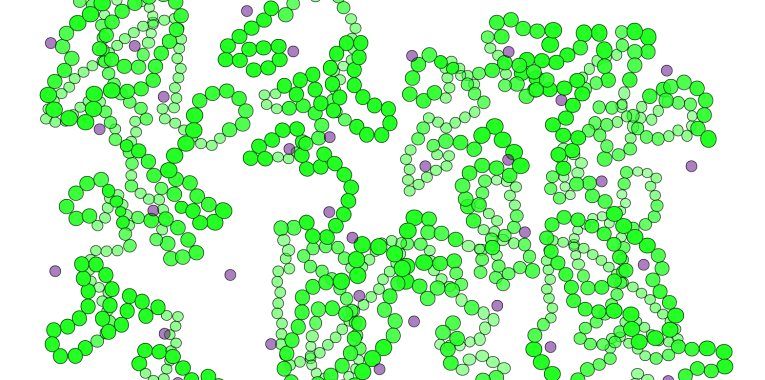
But the most interesting result by far is that we once again found a novel operational-mode. If the accumulation wall (the bottom wall) has an extremely large slip and the external field is strong then the retention ratio rises surprisingly rapidly over a small range for the tiniest particles. Mathematically, this looks like the hydrodynamic chromatography regime of FFF but the particle size range and the resolution are more comparable to Normal-Mode FFF so we call this new mode slip-FFF.

Find more details or the citation for this in our article in the Journal of Chromatography A.

Polyelectrolyte Brushes

Nanoengineering surfaces is a concept that comes up at multiple occasions within these research projects. I’m fascinated by the idea of constructing something that is nanoscopic in at least one dimension that can have macroscopic effects on the operation of a technology. In all these projects, the idea is to use nanoengineered surfaces as components in lab-on-a-chip systems.

One appealing idea is the concept of smartnanochannels, i.e. channels that would respond to stimuli such as variation in temperature, pH, or concentrations of specific chemicals. The most obvious surface modification that could have the potential to respond to such signals is grafting (or otherwise associating) polymer chains to interfaces. In fact, it is charged polyelectrolyte brushes that have the greatest potential as smart brushes. Because of the long-range electrostatic coupling between chains and free counterions, the structure of polyelectrolyte brushes depends sensitively on many factors, which could be used to switch the brush from one state to another.

Swelling and deswelling by an external voltage, applied normal to the grafting surface has been experimentally demonstrated and suggests a convenient and quick switch that acts on both the polyelectrolyte brush and also the counterions suspended in the solvent. The extension/collapse transition could act as a stimuli responsive gate, limiting the passage of flowing fluid or ions and so has potential in the design of functional and controllable MEMS devices.

With our collaborators Dr.Pai-Yi Hsiao and his student Yu-Fan Ho from the National Tsing Hua University, we have found some very interesting results from studying this system. More to come once we know where our manuscript stands. For now you can read more about the electrohydrodynamics of soft surfaces in our review on electrophoresis.

Electrophoresis Algorithm with Finite Debye Layers

We have developed a hybrid MD-MPCD algorithm to simulate the electrophoresis of polyelectrolytes in a way that coarse-grains electrostatic interactions.

The Problem

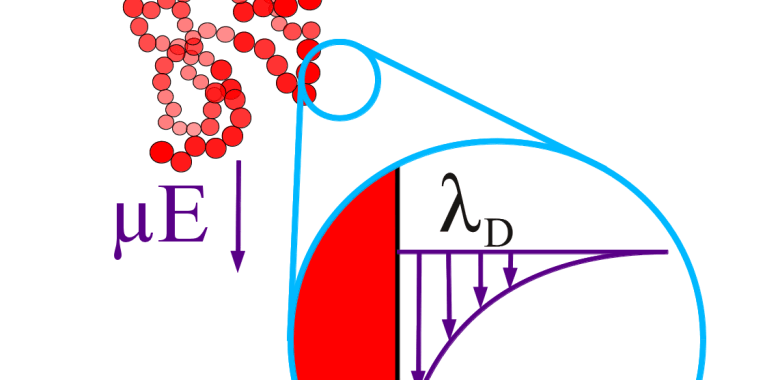
A charged monomer in solution attracts oppositely charged ions out of the fluid to form a counterion sheath. This is called the diffuse Debye layer and the charge density of the Debye layer obeys the Poisson-Boltzmann equation for which there is no analytical solution for a spherical monomer. If the potential is rather small then the Debye layer can be described by the Debye-Hückel approximation (the counterion density decays exponential over the characteristic Debye length).

Beyond the Debye length, electrostatic interactions are screened by the oppositely charged cloud of counterions. Perhaps more surprisingly, hydrodynamic interactions due to electrophoretic motion are also screened. To understand why imagine that the monomer moves under the action of an electric force. It shears the fluid, pulling it along with it. But the counterion sheath has an equal but opposite charge. The field forces it in the opposite direction and it also shears the fluid. The shears (almost) cancel out. (I throw in the “almost” because there is a rapidly decaying shorter-ranged field that remains).

If you were reading carefully you noticed that I explicitly said that “hydrodynamic interactions due to electrophoretic motion are screened”. Normal, random motion from thermal noise or drag from pressure driven flows are not screened. When the polymer moves, its counterion cloud moves along with it (not against it as it did for an electric field). This means that the electrophoretic mobility looks like a free-draining (or Roussian) polymer but the diffusion coefficient (hydrodynamic mobility) looks like a hydrodynamically oblique (Zimmian) polymer.

Electrophoresis: When Hydrodynamics Matter

So you see that hydrodynamic interactions are usually screened in charged polymers. But this isn’t always the case. You can read all about cases when this screening isn’t perfect in our review if you are interested.

In order to study systems in which hydrodynamics aren’t perfectly screened a coarse-grained algorithm that can properly account for the electrohydrodynamics is needed. Usually simulations that account for both hydrodynamics and electrostatics are compuationally expensive (both hydrodynamics and electrostatics are long-range and computationally intense) or are only valid in the infinitely thin Debye layer limit. We developed an algorithm for the electrohydrodynamics of polyelectrolytes that is less computationally intense but is still accurate for finite Debye layers.

We embed a charged MD polymer in an MPCD fluid (as a detail the MD beads are included in the MPCD collision step to couple the polymer to the fluid). At each time step, we use the counterion distribution from the Debye-Hückel approximation to bestow MPCD particles with a temporary charge. When an electric field is applied the MD beads are forced in one direction (electrophoresis) and their not-explicitly-included-counterions are forced in the opposite direction (electro-osmosis). During the MPCD collision step this momentum is mixed – the MD beads shear the fluid and the electro-osmotic flow drags on the MD beads. For long polymers in free-solution this cancels out so that the mobility is length independent. For short chains, the experimentally observed rise is obtained (one point that I didn’t mention is that MPCD particles can get charge from multiple monomers and if their charge becomes to great they are said to “condense” to the chain, which is to say they loose all their charge and the monomers that they got their charge from also loose it. This Manning condensation is very important but if you are worried about these sorts of details you really should go read our paper).

Now we use this algorithm to study situations in which we are either unsure whether hydrodynamic interactions are totally screened or the impact of partial screening. This work was extended to look at electro-osmotic flow generated by tethered polyelectrolytes when I visited Dr. Pai-Yi Hsiao at the National Tsing Hua Univeristy in Taiwan. Currently, Martin Bertrand and I are using it to investigating some surprising effects of confinement on electrophoresis.

This algorithm was developed with Owen Hickey.

Unified, Ideal FFF

Field-Flow Fractionation (FFF) is an elegant separation technique because it is a simple concept that is extremely broad in practice:

An external transverse force is applied across a channel to a solution of solutes (maybe colloids, maybe polysaccharides maybe cells, whatever). The perpendicular field pushes the ensemble of solutes against the bottom wall but diffusion disperses the solutes and resists the inhomogeneity. The competition between thermal and potential energy results in an exponential concentration distribution in equilibrium. Importantly, each species of solute has a different concentration profile (perhaps because they have different masses if gravity or centerfugation is being used or because they have different charge if an electric field is being used, etc).

If nonuniform flow profile carries these solutes through the channel, their elution times will differ. Since each species has a different concentration distribution, each species samples the velocity distribution with a different weighting and so has a different mean velocity. Solute particles near the wall are subject to slower flow than particles near the centre; therefore, samples with a mean height close to the wall are carried along with a slower average velocity than samples with a larger mean height.

This seems simple enough but interestingly this simple system possesses surprisingly rich elution behaviour.

Hydrodynamic Chromatography

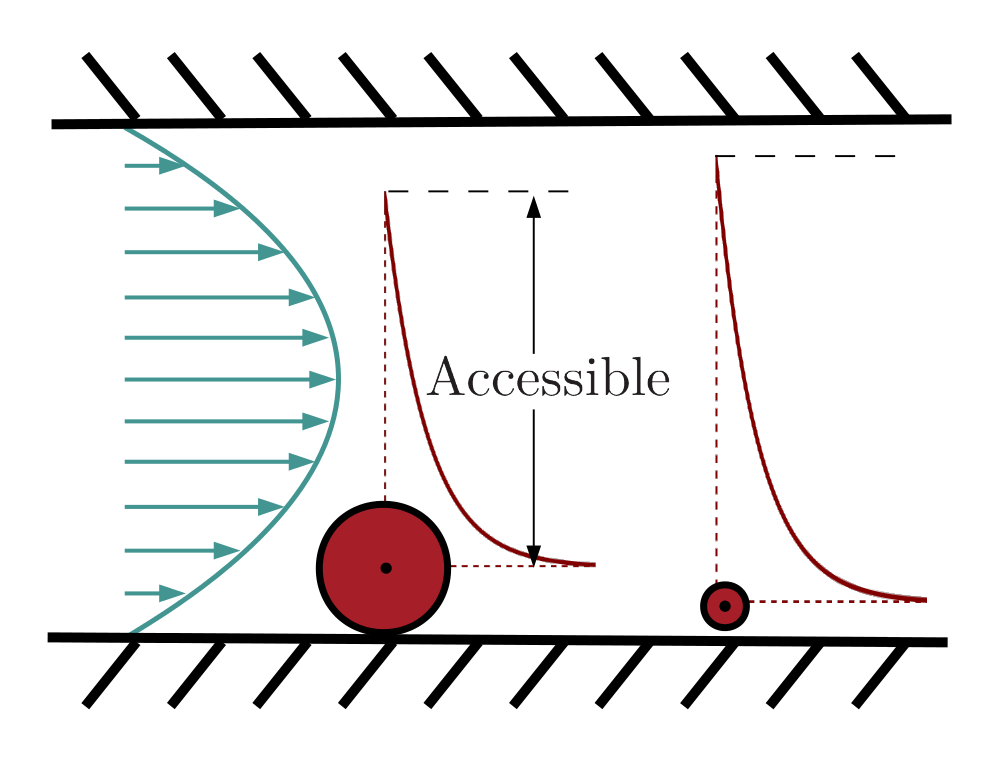
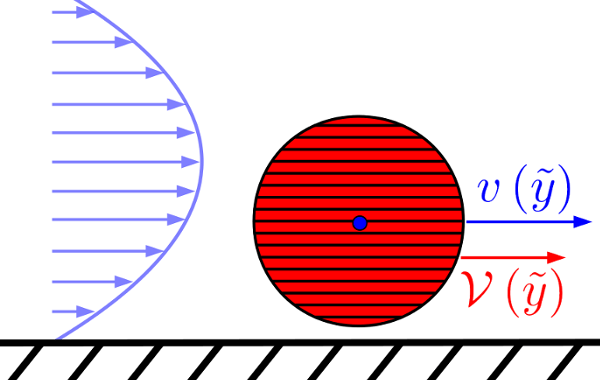
Imagine that the external field is turned off or negligible. In this case the solutes can diffuse across the entire extent of the channel and uniformly sample the parabolic velocity distribution. EXCEPT that there is an excluded region near the walls. If the solutes are hard spheres then there is a stericly excluded film that is exactly equal to their radii. This excluded zone changes with particle size and so the average solute velocity is different. This is the basis of Hydrodynamic Chromatography.

Normal-Mode FFF

If instead we imagine that the field is strong and the particles are small (so small that we might model them as point particles). Then we only need to average the parabolic fluid velocity weighted by an exponential probability distribution. The particle velocity wouldn’t have an explicit size dependence (since it would be modelled as a point particle) but only a external force dependence.

Steric-Mode FFF

As the particles get larger and larger, the point-particle approximation breaks down and one needs to include both the external force on the colloids and the steric force when they interact with the wall.

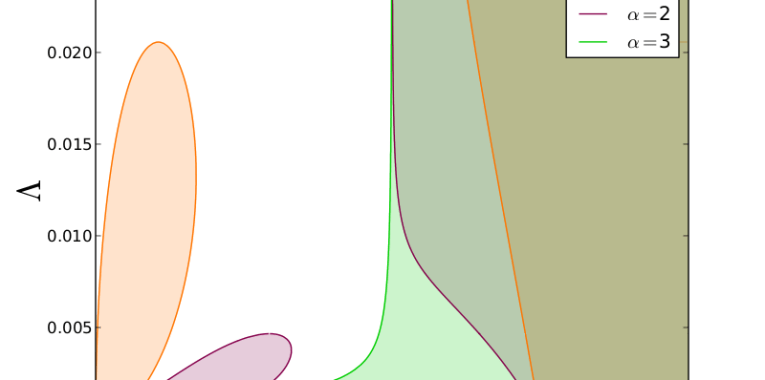
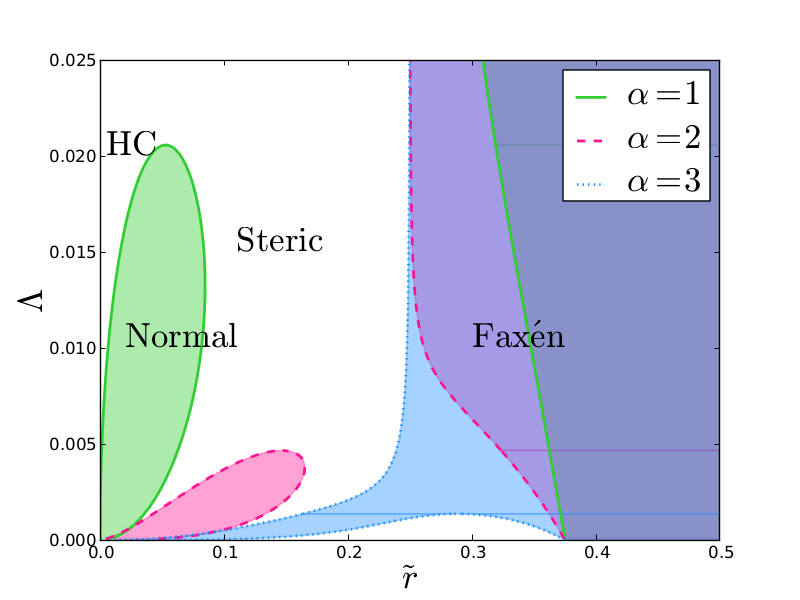
We were able to combine all three of these “operational-modes” of FFF into a single unified theory by simply writing the retention theory explicitly in terms of particle size. When this is done FFF retention theory can predict all three modes and the transitions between these modes.

Faxén-Mode FFF

We were happy to have a unified theory but found that when we let the particle size approach the channel height the particle was predicted to go 50% faster than the fluid — a highly unlikely thing. So we went back and added a bit more hydrodynamics: We integrated the stress on the particle due to the fluid flow. Because the fluid profile is parabolic, the particle moves slightly slower than the carrier fluid, which of course means that the particles elute later than if this effect were neglected.

We mapped out the transitions between these ideal modes of operation.

Find more details or the citation for this in our article in the Journal of Chromatography A.

Multi-Particle Collision Dynamics

Physics is a science of models. The equations that we write down and the schematics that we draw are necessarily simplifications of reality but they capture some aspect of existence that we consider to be most important. The best models describe many situations while remaining simple. At times, our models can be stunningly simple and yet surprisingly ubiquitous (like the simple harmonic oscillator). At other times our models can be simple in concept yet require computers to solve (like a Lennard-Jones fluid).

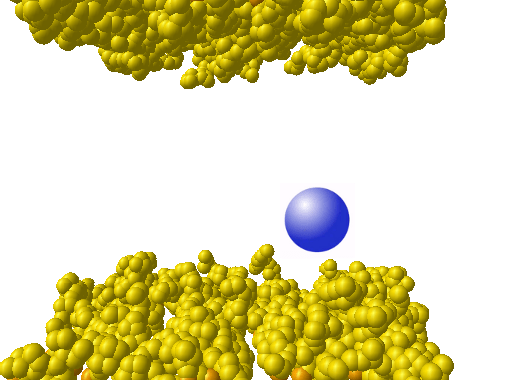
Molecular Dynamics is a computational technique that considers spherical fluid molecules that interact through pair-wise Lennard-Jones potentials (check out our review for more details). But calculating the force between each pair of particles for each time step is a costly procedure. At times, more coarse-grained models of fluids will suffice.

One such model is Multi-Particle Collision Dynamics (MPCD), also called Stochastic Rotation Dynamics (SRD) (which, if you keep reading, you’ll realize is a specific MPCD realizations) or Real-coded Lattice Gas (RLG).

In MPCD collisions between fluid particles are replaced by multi-particle collision events that omit the molecular details and eliminate the need to calculate long-ranged forces between the fluid particles. These collisions are not physically insightful but rather are just constructed to conserve mass, momentum, and energy such that the hydrodynamic equations of motion are obeyed on sufficiently long length and time scales.

Details

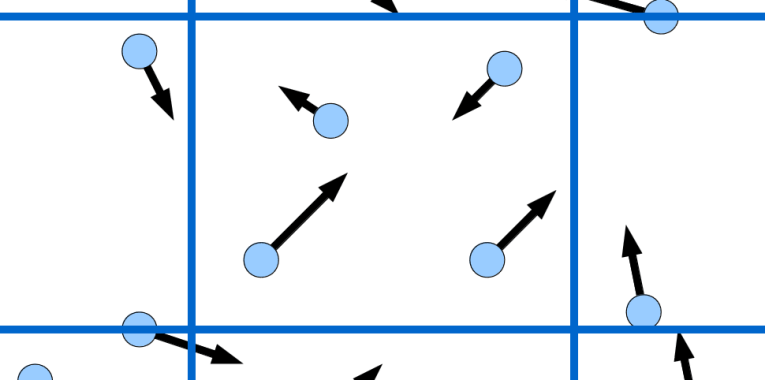
MPCD simulations occur in two steps. During the first, or streaming step, the particles move ballistically, and their positions are updated in discrete time intervals δt. During this portion of the algorithm the particles are simply an ideal gas. The second, or collision step transfers momentum between particles. The simulation domain is partitioned into cells. The number of particles in each cell may vary from one cell to another but the total number is conserved. Each cell has a centre of mass velocity, which corresponds to the local macroscopic velocity. Again, the collision step is a simple non-physical scheme that is constructed to conserve momentum. There are many different choices for this collision operator:

Stochastic Rotation Dynamics – The collision operator is a rotation through a given angle (which sets the fluid viscosity) about a randomly chosen axis. The randomly chosen axis can either be a random choice between a given set of orthogonal axes (say x,y,z)) or a random axis can be generated for every collision event.

There is a nice version of MPCD that includes an Andersen thermostat as an integrated parts of the simulation technique. I’m particularly fond of this collision operator. It simply generates random velocities from a Maxwell-Boltzmann distribution. It sets the velocity of each particle in a cell to be the cell’s centre of mass velocity plus a random velocity minus the average of all the random velocities generated for that cell.

Another thermostatted MPCD algorithm uses a Langevin thermostat with noise and a friction terms. My code has this version implemented as well but I tend to use the Andersen-MPCD version most.
A few of these collision operators can be extended to conserve angular momentum within collision events but this is usually not an issue for the systems I am concerned with.

A sharp reader may have noticed that Galilean invariance is broken by the discretization of space into cells in the MPCD algorithm. If the mean-free path of the molecules is comparable or larger than the cell dimension then this is a relatively insignificant effect. However, this can be completely remedied by performing the collision operation in a cell grid which is shifted each time step by a random vector. Galilean invariance is then restored.

A wonderful interactive can be found on the Institute of Complex Systems’ webpage.

More information about MPCD and other simulation techniques that we often use in Dr. Gary Slater’s research group can be found in our review of computational methods.

Uses

The MPCD code has proven a useful tool for revealing the behavior of solutes eluting through microfluidic devices while subject to an external, normal field. In this case, MPCD simulations corroborated experimental findings (with Dr. Michel Godin’s research group) and led to a numerical model for the retention of particles as a function of size.

We have also used it to study electrophoresis of polyelectrolytes and polyampoholytes, to look at electro-osmosis around a tethered polymer and to study polymer brushes.

Polyampholytes

An interesting application of our mean field MPCD-MD Debye-Hückel algorithm is the determination of the electrophoretic mobility of net neutral polyampholytes.

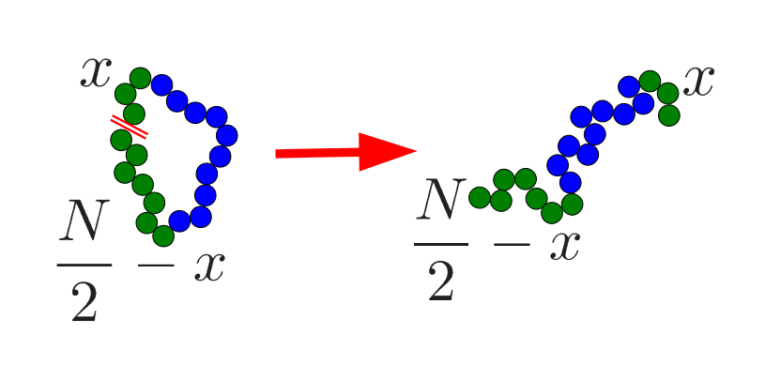
One might think that since the chains have a net neutral charge that an electric field can’t induce them to electrophorese but this isn’t true. We investigated net neutral diblock ring polymers cut to create a net neutral linear triblock polyampholyte with a negatively charged centre. The ends were both positively charged but had different lengths.

If the cut makes a diblock polyampholyte then the mobility is indeed zero. But if the cut is at any other position they have a non-zero mobility. The mobility is largest for symmetric triblock polyampholyte (one little detail here – non-monoticity can occur if the field is large enough to fold the chain over and polarize).

Why is there a non-zero electrophoretic mobility? The monomers at the ends matter more than those in the centre. Less counterion condensation occurs at the ends and their effective charge is significantly higher. For this difference to be apparent, the Debye screening length must be significantly smaller than the length scale of the charge heterogeneity of the polyampholyte. This means that the electrophoretic mobility is large for thin Debye layers and disappears as the Debye layer thickens.

Find more details or the citation for this in our article in the PRL.

Brush FFF

A soft-matter technique for nanoengineering surfaces is to graft or otherwise associate polymers to a hard surface. These polymer brushes are fascinating in their own right (you can read about our work on polymers grafted to the inside of capillaries or polyelectrolyte brushes subject to normal electric fields on this site) but they can also be used as components in microfluidic devices.

An idea of ours is to use a polymer brush to improve Field-Flow Fractionation (FFF). We have developed an ideal theory that accounts for retardation of flow within the brush and the free energy cost of solutes to entering the brush (which depends on the difference between particle size and grafting density (or brush height if the particle is large enough)), which suggests that there is a size range in which separation can be greatly improved by the presence of the brush and are currently running MPCD simulations on this system.

More to come on this project once we publish our work.

FFF in Microfluidic Channels

The ideal, unified Field-Flow Fractionation (FFF) analysis, suggested that a novel operational-mode exists at the largest particle sizes. Therefore, our collaborators in Dr. Michel Godin’s laboratory constructed a 18micron microfluidic channel to to test this prediction for polystyrene colloids subject to a gravitational field and to determine how well the retention theory would match experimental data across multiple operational-modes.

Our work has recently been submitted for publication. The manuscript presents experimental data, MPCD simulations and a modified, numerical retention theory to build up a consistent picture of FFF of large colloids eluting through microfluidic devices.

uOttawa’s Centre for Catalysis Research and Innovation creates intersections with industry

OpenLab

Gazette
published: Nov 2

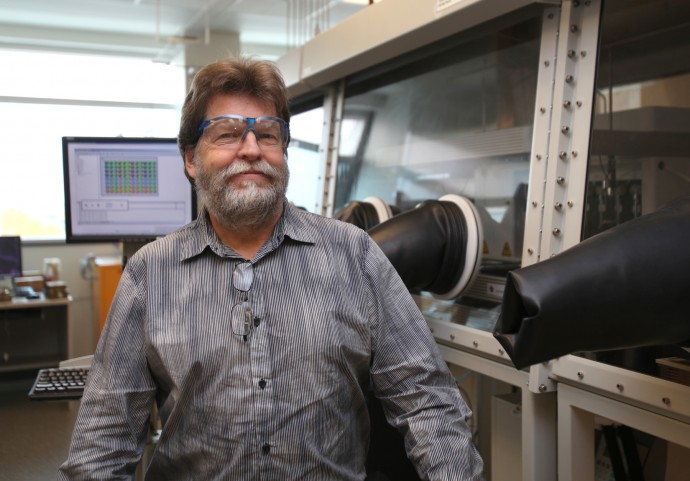
The CCRI’s robotic catalyst synthesis tools (pictured behind Professor Baker) allow the researcher to run a large number of reactions at once on a very small scale in a fully-automated fashion, minimizing cost, time, waste generation and experimental error.

The Scientist
Tom Baker has done a lot of chemistry. In fact, he was recently awarded the Canadian Green Chemistry and Engineering Award from the Chemical Institute of Canada for his contributions to catalysis science geared towards energy applications for sustainable and green chemistry.

Before arriving at uOttawa, Tom spent fifteen years at DuPont CR&D developing applications for homogeneous catalysis involving fluorochemicals, titanium dioxide, and nylon intermediates. In 1996 he joined the Chemistry division at Los Alamos National Laboratory where he led projects in bi-functional and multiphasic catalysis approaches for alkane functionalization and chemical hydrogen storage. In 2008 Baker joined the Chemistry Department at uOttawa as Tier 1 Canada Research Chair in Catalysis Science for Energy Applications and became the Director of the Centre for Catalysis Research and Innovation.

The Science Centre
The Centre for Catalysis Research and Innovation (CCRI) is a huge (18,000 sq. ft.) state-of-the art facility housed in the Biosciences Complex, andfeatures robotic chemistry tools for rapid discovery as well as microscopes that can ‘see’ the elements in very small catalyst particles. The CCRI comprises thirty university researchers who each study catalytic chemistry but come from all across campus, making the centre both multidisciplinary and yet highly focused. Baker sees the CCRI as an ideal hub for collaboration: through the centre the University of Ottawa can offer its catalysis research scientists  equipment that would otherwise be unaffordable.

One of the Baker’s projects is to use the CCRI to study is how certain metal catalysts (catalysts are guest chemicals that speed up the rate of a chemical reaction) could be used to selectively break carbon-carbon bonds in wood-derived lignin and so convert biomass into usable energy.

The Solution
Not only does the centre attract world-class researchers (six are Canada Research Chairs) and outstanding students, but it also partners the University of Ottawa with industry.

In many ways, these partnerships lie at the heart of how Baker runs the CCRI. He pushes researchers to move beyond the one-researcher-with-one-company-for-one-project-type of collaboration into collaborations between two or three companies and a half dozen university researchers at one time. Baker and the CCRI are building bridges to help move scientific discoveries from the ivory tower into the Canadian economy with greater fluency.

Baker says, “It’s an exciting time. We’re starting to see our centre become a resource across the country and we expect to see that more and more.”