Science Journalism

A Sheep in Wolf’s Clothing

Scientist on Assignment

Department of Physics Blogs
Published: August

Today was all business. I got in knowing exactly who I needed to contact for the stories that I was working. By the time the newsroom started to fill, I was well on my way, which is good because my deadline got moved ahead. By the end of the day, I had finished two brief articles, which will published this weekend. They both needed a substantial working over by real journalists before they could be submitted but they got done. Tomorrow, I attend my first press conference, which should be lots of fun.

One of the stories that might not get covered is about sheepdogs herding flocks of sheep. The researchers’ model is super simple and I think that instead of writing a better blog post tonight, I will try to reproduce their algorithm.

Small World

Scientist on Assignment

Department of Physics Blogs
Published: August

Day one done.

It started off pretty slowly. I woke up early (for an academic) and caught the bus into London. While riding in, I wrote today’s first blog post and got to the FT with plenty of time to spare. I even sat in a cafe and did a bit of physics.

When I arrived in the newsroom, I was shuttled off to sign forms and and learn the content management system at the FT. This is a program that organizes the article submission and metadata. It’s all pretty cut-and-dry: it’s just html-like markup but journalists have to click buttons with a mouse in order to make the header, make an internal link, or anything else.

Going through this program seems to be journalists’ equivalent to doing a WHMIS exam for scientists: its basically common sense and you already vaguely know it all because it’s nearly the same as the household version but it’s important to that everyone does it.

Then things got busy and fun. I was dropped off on the newsroom floor and was immediately given a stack of background material on a company. In ten minutes, I had to be ready to accompany Clive Cookson on an interview. Luckily for me, a big part of the company’s R&D is focused on improving nutrient-uptake in agriculture, which is the same research that is done by the company that my Dad worked for while I was growing up. I wouldn’t be surprised if my Dad knew the CEO. In fact, the CEO is from and still farms in the small part of Canada where I was raised!

I felt completely at home. What a small world.

Getting my Ducks in a Row

Scientist on Assignment

Department of Physics Blogs
Published: August

I’m on the bus heading into London for my first full day at the FT. It’s the Tuesday after the long weekend but I’m not as rested as that might lead you to believe. Being a BSA media fellow will take me out of the lab for an entire month, which is a long time for a post-doctoral researcher. It will be entirely worth it but disappearing for such a long amount of time requires putting my house in order.

Over the weekend, I had to write up a brief contribution to the Supporting Material of a collaborator’s thesis, re-submit a manuscript and complete a response to referee reports. Usually, this is all just mundane business but I doubt that I’ll have much time or energy to work on these this month and none of these jobs can just sit on my computer collecting dust for that long. None of this work has to do with my current work at Oxford — they are all loose ends from my Ph.D.

My current research had a successful month. I say “my research had”, rather than “I had” because theoretical work, perhaps like artistic endeavours, cannot always be forced. Just because I work hard does not always mean that concrete progress is made. But this month was good. I’ve been constructing a coarse-grained computer algorithm for simulating flowing (nematic) liquid crystal fluids.  At the beginning of the month, it wasn’t clear to anyone that my idea could actually be realized into a computationally useful algorithm but it’s clear now that it will work. There are, of course, still wrinkles that need to be ironed out but all-in-all I’m excited about it. I wonder if I’ll be able to fit a little development in on the side while working at the FT. I do have these daily trips into  London, after all.

First Time to the FT

Scientist on Assignment

Department of Physics Blogs
Published: July

Today I visited the Financial Times newsroom for the the first time.

There was no immediate reason to visit except that the FT science editor, Clive Cookson, and I had yet to meet in person. We’d only spoken briefly over the phone back in May before the BSA placements were announced but that was an interview. This was an introductory visit.

It was also a test run of sorts, since I’ll be commuting into London from Oxford for my placement. The trip is more than 2hr long and I may learn to hate it by the end of my placement. But everything went smoothly today, though I did arrive a full hour early (better than a minute late, I suppose).

Cookson and I had a cup of coffee, chatting about the news of the day: Sink holes and fraudulent Taiwanese researchers are interesting enough but nothing is more newsworthy than the west African breakout of ebola (which apparently needs to be added to my growing list of words that I, as a Canadian, pronounce with an American accent). Ebola has been trending on my science-focused Twitterfeed and seems to be a textbook example of a timely news story with an essential science component. It is a tragedy with nearly 700 confirmed dead since February (including a top doctor); it is rightfully worrisome since global pandemics are a real concern; it is an international political issue with Nigeria acting decisively and UK ministers meeting to discuss the outbreak; and it has epidemiological and medical underpinnings. FT readers are getting both the scientific background on the disease and reports on the medical measures being taken to halt the epidemic.

Cookson was about to join the World Weekly podcast with host Gideon Rachman and Africa editor Javier Blas and invited me to come see the process. This was great for me because podcasts are one of my favoured forms of media. I was surprised how smoothly the recording went. The three of them sat down, chatted a moment and then recorded the entire podcast in a single take. It was all very professional.

Afterwards, we visited the newsroom, which is much like other newsrooms that I have seen. It was a big, open, bustling space but the science writers, including pharmaceuticals correspondent Andrew Ward, are tucked away on a quieter floor. This is where I’ll be when there. I can’t wait to get started.

Hello, World!

Scientist on Assignment

Department of Physics Blogs
Published: July

Hello, world. Welcome to Scientist on Assignment, a blog that I will use to share my personal experiences as an Oxford scientist working at the Financial Times for a month.

I have this wonderful opportunity to see how the media covers science through a British Science Association Media Fellowship. Every year, the BSA places ten scientists in newsrooms throughout the UK to build and strengthen bridges between science and journalism.

As a young computational biophysicist, I don’t have much free time; however, I applied for a month-long BSA placement because I strongly believe that we scientists have a responsibility to share what we discover. We do this in three principle ways: We report to our peers through journals and conferences; we teach students in lectures and through supervised projects; and we communicate our findings to the public. Engaging with the public is traditionally the least emphasized and often it is not much more than an afterthought. My BSA Media Fellowship is an opportunity to carry out this responsibility by reporting on exciting scientific findings to the readers of the Financial Times.

Although primarily a financial news publication, the FT superbly covers science news. Science coverage is the domain of science editor Clive Cookson, whom I shall report for while at the FT. The FT operates online with a paywall, meaning that much of the content requires a subscription or at least registration (8 free articles per month). Oxford’s Bodleian Library has a full subscription for academics.

What will I be doing at the FT? I don’t know yet. I don’t begin until August 26th 2014 but I have been informed that I should expect to be dropped into the deep-end — that I will be interviewing, writing and generally reporting science content right off the bat.

This blog (along with my twitter account @BuildingInThere) will informally report my thoughts and experiences with journalists and the media as an embedded scientist. Here, I’ll write about my excitement and frustrations. I’ll summarize what I’m learning and I’ll tell you about the hard days. I hope that readers will let me know about their experiences with science in the media or make suggestions about how this blog or anything that I write could be improved. Expect an exciting month watching a fish out of water.

TEDx comes to the U of O

the Fulcrum
Published: Oct 17

tedxUottawa

Photo illustration by Mico Mazza

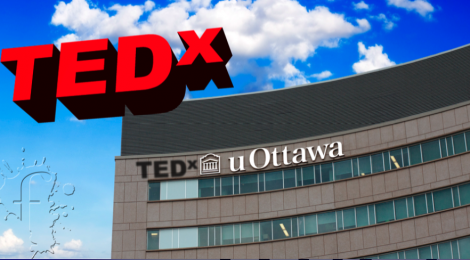
ON SATURDAY, OCT. 13, just over 100 idea-seekers gathered in the Alumni Auditorium to participate in TEDxUOttawa, a conference of ideas. Hosted by the Student Federation of the University of Ottawa (SFUO) and licensed through the popular TED (Technology, Entertainment, and Design) conferences, the sold-out event brought students, teachers, and alumni together to participate in a day that promotes the dissemination of—as TED’s slogan states—“Ideas worth spreading.”

Check out the highlights of TEDxUOttawa

Though the event was limited to only 100 people, ticket-hopefuls waited at the door nearly an hour before the start time of 10 a.m. to claim any available seats.

“People get really excited about TEDTalks,” said SFUO president and event coordinator Ethan Plato. “We had a lot of people calling, asking, ‘Where’s the TEDTalk?’ … [TED] has that ‘wow factor’ that gets people out.”

With over 3,000 community events organized worldwide and over half a billion views of TEDTalks available free online, it’s not difficult to see why the U of O community was excited to enjoy a local TED experience.

TEDxUOttawa featured presentations by professors, students and recent alumni of the U of O on the theme of “Innovation & Creativity.” Without exception, the speakers rose to the occasion and despite the broad theme, the talks fit well together. The event was live-streamed by Zoom Productions, the SFUO’s video production company.

“We don’t usually do live-streaming,” said Imani Wilmot, editor at Zoom. “This is the first time that Zoom is ever doing live-streaming of any kind of event … It’s awesome that we can even provide this kind of service.”

Through the TEDx license, any of the TEDxTalks could be chosen by the central TED organization to be posted at TED.com. The TEDx license is an independently organized TED event. As Matthew Staroste, TEDxUOttawa’s live blogger, explained, the videos will be available to everyone.

“It’s about promoting greater ideas in general, so the SFUO will be posting the rest of these videos on the TEDxUOttawa.ca website so that folks who either couldn’t tune in to the live-stream today or couldn’t be here in person can still be part of a TEDx experience,” said Staroste.

It was universally acknowledged that the U of O’s first TEDx experience came about largely thanks to one person.

“This is Jozef Spiteri’s brain-child,” chuckled Staroste.

Spiteri is the vp social of the SFUO and has harboured a dream of hosting a TEDx conference at the university for nearly as long as he’s been a student here. Spiteri even held the license for TEDxUOttawa for two years prior to becoming an executive member of the SFUO. He said he didn’t have to convince the rest of the SFUO executives that hosting a TEDx event was worth the time and effort.

“Everyone seemed interested,” said Spiteri. “Everyone was motivated. So when I got elected, I kept working on it and kept in contact with the people at TED.

“One thing that we need on campus—especially coming from the SFUO—is a more academic twist,” said Spiteri immediately after the TEDx event. “It gives an idea of what this community is and what it has to offer.”

TED conferences are part of an international set of conferences founded in 1984 by the private non-profit Sapling Foundation. The talks were originally planned as a one-off, but they expanded as their popularity grew.

Best of TEDx

THE TEDxTALK AT the U of O was a big success and showcased the best and brightest our university has to offer. Here are some of our favourite speakers of the day.

Mark Salter, professor of political science

“What is the point of education if the information is available to all?”

While teaching one day, Salter realized that lecturing was an outdated method of education. No longer seeing himself as a “gatekeeper” to knowledge, he now crowd-sources his syllabuses, giving students the power to decide what they study.

Andrew Pelling, assistant professor of physics

“You know, it used to be that in these type of talks, I could be a bit more creative and wild, but I’ve noticed that I’m just doing this everywhere now.”

Pelling wowed the crowd with his laboratory’s ability to hack biological systems the old-fashioned way—rather than altering cells’ genetic codes, Pelling can create surprising biological systems by altering their surroundings. Growing mice cells in the cellular scaffolding of an apple core was a clear crowd favourite.

Robert McLeman, associate professor of geography

“I learned a ton this morning… I mean, I didn’t know that you could grow mouse cells inside an apple core. It kind of frightens me that you can, but it’s interesting to see that people on campus are doing that.”

McLeman warned that the coming climate change will have a major impact on human migration patterns but also advised against being afraid of waves of environmental refugees, reminding the audience that Canada is a country of immigrants that could benefit from those seeking a fresh start.

Lee Jones, founder and editor of Art & Science Journal

“How do we encourage moments of awe and wonder in everyday life? … Artwork with themes of science, nature, and technology can be catalysts for eureka moments.”

Jones is a U of O student but also the founder and editor of the Art & Science Journal. Through her journal, Jones uses the collision of art and science to foster a sense of wonder.

Alyse Schacter, U of O health sciences student

“It was amazing. I think everybody learned from everyone who was there. We all had very different topics.”

Schacter, a 21-year-old advocate for the de-stigmatization of mental illness, spoke candidly about her experiences with severe treatment-resistant obsessive-compulsive disorder and advocated that openness can reduce suffering.

Lasers, hell yeah

What’s he building in there?

the Fulcrum
Published: Oct 10

The problem

Science and art are sometimes seen as the incompatible arch-enemies of human endeavours. But art can inspire science, and science can animate art.

The researcher

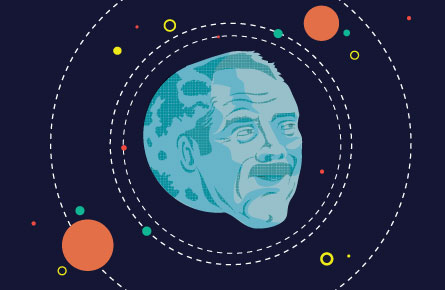
Christopher Smeenk, PhD candidate at the University of Ottawa, researches ultra-fast laser pulses at the NRC-uOttawa Joint Attosecond Science Laboratory. He is also a musician who plays guitar and French horn. For Smeenk, there is no sharp separation between science and art, and no reason why they can’t be blended.

The project

Smeenk is fascinated with the idea of creating performances that can be appreciated by more than one sense. In his eyes, visualizations during musical acts are separate performances, layered over the music—the instrument that produces the sound is distinct from the system that creates the visualization. His ideal is an experience that merges sensations, so Smeenk invented an instrument that creates both sound and light simultaneously.

The key

Smeenk calls his instrument the Laser Musicbox. Extremely short infrared laser pulses blast through the air, tearing electrons off their atoms and creating plasma. This short-lived plasma is the cause of both the sound and the colour. The hot plasma rapidly expands into the cool air around it, generating a shock wave (this is actually how lightning makes thunder). Smeenk fires laser pulses in quick succession, creating a train of shock waves. The space between the waves sets the notes we hear.

But the plasma does a second thing: light can travel faster through the plasma than through the air. This shifts the visible light from infrared to a beautiful oily continuum of colours. The shorter the laser pulse, the more colours are produced.

The laser that the Laser Musicbox needs to function is permanently housed in a National Research Council (NRC) laboratory, but Smeenk points out that the first laser was the size of an entire room. He expects that as technology moves forward, the Laser Musicbox could become a mobile instrument, and looks forward to working with musicians and composers. Rock on, lasers, rock on.

They’re building an ARC

No, not Noah’s—U of O to build Advanced Research Complex

the Fulcrum
Published: Oct 3

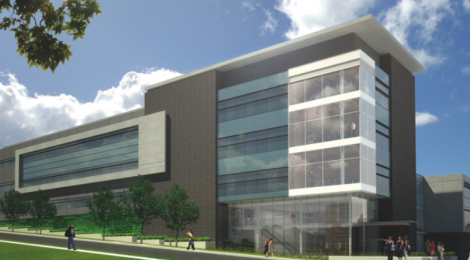
ARCIllustration courtesy of the University of Ottawa

On Sept. 26, the University of Ottawa broke ground on a five-storey building that will house the new laboratories of three of its most prominent researchers. Called the Advanced Research Complex (ARC), the building will be located on the east side of King Edward Avenue, across from the Minto Sports Complex. The ARC, scheduled to be completed in the summer of 2014 at the earliest, will provide multi-million-dollar laboratory space to the university’s vibrant photonics community.

According to Mona Nemer, vice-president of research at the U of O, the new building will make the university a leader in the field of photonics.

“ARC says something about where the university currently is and where it is going,” said Nemer.

The philosophy behind ARC is to bring researchers working in the fields of photonics and geosciences together into one space, regardless of their department or faculty. According to Thomas Brabec, chair of the department of physics, the complex will bring several faculties together.

“The final plan would be to move engineering and physics photonics together,” said Brabec. “The drawback is that the physics department is going to be split in half … but it might not be so bad.”

Paul Corkum, one of the three lead scientists responsible for ARC, agrees that organizing scientists by research interest rather than the traditional department won’t be an obstacle.

“As you build the photonics, you really want to bring people together,” said Corkum. “You want the engineers to know the scientists and the students to talk to each other. That’s how science works. So right from early on we wanted to bring people together.”

Corkum, who currently studies ultra-fast laser pulses in his laboratory at the Steacie Institute for Molecular Sciences at the National Research Council of Canada on Sussex Drive, will move to the ground floor of ARC in order to join fellow physicist Robert Boyd and geologist Ian Clark in the state-of-the-art facilities on campus.

Boyd, a world-renowned physicist who studies quantum nonlinear optics, joined the department of physics as the Canadian Excellence Research Chair (CERC) in 2010. The CERC position comes with $10 million in research funds, which Boyd will use to study how the velocity of light pulses travelling through material systems can be modified and controlled.

While Boyd recently moved to the U of O, Clark has been in the department of earth sciences for 30 years. His new laboratory in ARC will house a novel accelerator mass spectrometer that will rocket ions to nearly 10 per cent of the speed of light with very little sample contamination. This will allow Clark to detect the presence of trace radioisotopes at much lower concentrations than traditional mass spectrometers do.

“[The] instrument is actually built and ready to be delivered,” said Clark. “So it will be put into storage temporarily in Holland where it was built.”

Although the ARC building won’t be completed until 2014, Clark’s mass spectrometer will be installed early, in the fall of 2013.

“I tell you without a hint of exaggeration or hubris, our group is the best in the world for developing these new sources and technologies,” Clark said. “It is essential—and the university has been behind us on this—that we stay on top of our game.”

In many ways, Boyd, Clark, and Corkum will form the core of the research endeavors at ARC and are responsible for its creation.

In 2009, Corkum and Clark independently applied for large research grants, and the university submitted both applications to the Canadian Foundation for Innovation (CFI). Both applications were successful; CFI’s public records report infrastructure contributions of $4.7 million to Corkum’s project and $8.4 million to Clark’s.

“It wasn’t a joint project; there were independent applications,” explained Clark. “The two of them together were sufficient research mass to justify a new research building and that’s what [the university administration] was looking for.” The university pooled the funds to construct a single complex rather than two separate buildings or renovation projects for photonics and geology.

Corkum and Clark’s two CFI grants alone pay for 40 per cent of the construction costs of ARC. The Ontario government, recognizing the opportunity to have a world-class research facility in the province, agreed to match the CFI moneys, bringing the total to $25 million. Boyd contributed a further $1.5 million, and the university administration is covering the remainder of the construction costs (although according to the administration it has currently requested a further $2–3 million from CFI). A host of private partners have contributed to the scientific equipment that will populate the research centre.

Because of the sensitive nature of the optical and electron microscopy experiments to be performed in ARC, significant care was taken to design a building that would be stabilized against even the smallest vibrations from the outside world. In standard structures, wind, passing trucks, or even students running to class can cause tiny vibrations to reverberate through the building and misalign laser experiments.

“The ground floor is mechanically extremely stable,” said Corkum. “There was a big effort to maintain the stability of the laboratory. The basement floor will be isolated from the building, so if the building shakes, it’s okay; the floor doesn’t shake. And it will be locked to a seismic plate and  subsequently tethered to the base of the rock.”

Corkum’s laser system will be attempting to image flash frozen cells 50 nanometers (nm) at a time using highly focused laser beams to desorb molecules and reveal what each 50-nm area is composed of, which is the primary reason why ARC is located on the east side of King Edward Avenue.

“All signs pointed to the other side of King Edward,” said Clark. “It hit on all criteria: vibration, the space needed, and it was a ‘green field’—there were no encumbering things on site.”

One thing the U of O cannot afford to do is waste space; however, the core researchers need only two floors. Photonics researchers will be on the third floor and the fourth floor will be space for geoscientists. The three lowest floors of the complex will be completed by 2014, but the top two floors will be “shelved,” left empty as an investment in space for the university in the future.
Sieving and sorting cells

What’s he building in there?

the Fulcrum
Published: Sept 6

The problem

The microscopic world of E. coli and other bacteria is a mixed-up place. Some bacteria can swim from location to location—but a storm of random collisions with thermally raging fluid particles knocks the microscopic microbes for a loop. This diffusive mixing makes it next to impossible to keep bacteria with different mutations separate from each other.

The researcher

Yuguo Tao is a post-doctoral researcher in the department of physics at the University of Ottawa. Tao is a computational biophysicist who builds computer models to simulate the life of a cell. By letting many of these virtual cells move around, compete for food, divide, and eventually die, Tao has studied the behaviour of assemblies of many cells, such as the colonies of cells that form the living films on your bathtub or behind the tap of your kitchen sink.

The project

Tao is interested in building geometries that can trap cells of one type but not of another. With future devices of this kind, cells could be sorted, and diffusive mixing could be overcome.
One existing system that is able to do this is a wall with funnel-shaped openings. Previous experiments on E. coli using this setup have shown a difference in cell concentration between the two sides of the wall.

The key

Tao’s simulations show cells that don’t swim and only diffuse randomly will be found in equal concentrations on both sides of the wall, but cells whose motion is made up of random swimming (like E. coli) become concentrated toward the right-hand side of the funnels. The better they swim, the more concentrated the cells become.
Cells that swim are organized by the funnels: the number on the right and left sides of the wall is determined by cell size, rigidity and ability to swim. So by arranging many of these walls in a row, Tao can sort cells by their physical properties and keep different populations separate from each other.