Burying nuclear waste

What’s he building in there?

the Fulcrum
Published: Apr 4

The problem

A FIFTH OF the world’s uranium comes from Canada. CANada Deuterium Uranium (CANDU) reactors have been safely running since the 1950s, but nuclear energy is not without its problems. A handful of leaks have occurred, raising questions about waste management.
Storage of nuclear waste is a particularly important question right now as there is a proposal to build up to four new nuclear reactors at the Darlington Nuclear Generating Station on the northwest shore of Lake Ontario.
Plans to ship waste to depositories in the shield are controversial amongst northern communities and many critics are uncomfortable with the idea of transporting nuclear waste over such long distances.

The researcher

Ian Clark is a professor in the Department of Earth Sciences at the U of O who uses the environmental isotopes found in nature to investigate deep crustal water and geochemical and biochemical processes that occurred millions of years ago.
Clark drills for rock samples and then analyzes the water and gases that have been trapped in these rocks for millions of years. He can determine if the groundwater has been totally isolated or if, over millions of years, new water has been slowly moving through the rocks.

The project

Clark uses natural isotopes as a tool but that knowledge is also extremely useful for predicting the outcome of burying nuclear waste. He was asked to be part of a team that would assess a site at Kincardine in southern Ontario, close to both the Darlington and the Bruce Nuclear generating stations.

The key

The Northern Shield may sound like the perfect place to bury nuclear waste, but according to Clark, it’s not. Yes, the igneous rock making up the shield is hard so nuclear waste shouldn’t diffuse through it, but it has fractures. The shield is leaky because faults let water flow quickly from one point to another.
Kincardine is much better according to Clark. He analyzed rock samples from six holes drilled 850 metres down to sedimentary rock—formed from deposited sand and clay at the bottom of ancient oceans—at the Kincardine site. Clark ground up these rocks and baked fistfuls to get about two drops of water, water that had been trapped for some 400 million years. Helium was also trapped in the rocks for more than 260 million years.
As these rocks are very tight and don’t fracture, and the site is very close to Ontario’s fleet of nuclear reactors, Clark believes Kincardine is an ideal environment and much better than any in the shield to bury nuclear waste.

Nanoengineering cyborgs

What’s he building in there?

the Fulcrum
Published: Mar 14

The problem

CYBORGS AREN’T SCIENCE fiction. All around us people with pacemakers, insulin pumps, and prosthetic implants continue to live normal lives because of mechanical and electronic parts within their bodies. It’s not sci-fi; it’s mundane.
But that doesn’t mean combining human bodies with technology is scientifically simple. Even relatively straightforward implants need to be biocompatible or human tissues won’t accept them. Implants also need to be reliable.
We may take it for granted, but our bodies are amazingly robust. When we sustain injuries, we heal—but implants don’t. Hip replacements are some of the most successful prosthetics, but even they have a 20 per cent failure rate after 20 years.

The researcher

Amirhossein Ketabchi came to Canada to do his undergraduate degree in engineering at the University of Ottawa. Here he found a tight-knit community of students and decided to stay in Ottawa to continue graduate studies. Ketabchi is now a master’s student in the Surface Nanoengineering Laboratory with an interest in medicine and bio-materials.

The project

Titanium is one of the best bio-materials for implants. It’s light, strong, non-toxic, resistant to corrosion, and isn’t bad at osseointegration—the merging of bone and non-bone into a single object. Not all metals are good at this, but titanium isn’t bad. Ketabchi thinks he can engineer it to be better.

The key

In order to engineer better biocompatibility, Ketabchi modifies the surface of the titanium. Because your body’s cells are in contact with implants, modifications must change nanoscopic details. Ketabchi does this nanoengineering by dipping titanium into an acid mixtures. The acid causes an oxide layer of open nanotubes to form on the surface of the titanium, which human bone can then grow into. Nanoengineering the surface of titanium like this improves its biocompatibility.
But soaking metal in strong acid for hours and hours weakens it, and the last thing you want is a titanium pin in an implant snapping. So Ketabchi knows there has to be a tradeoff between biocompatiblity and preserving strength to withstand years of fatigue. He tests the endurance limit of pin after pin, looking for the perfect compromise between biocompatibility and strength.

Crammed in the capillaries

What’s she building in there?

the Fulcrum
Published: Feb 9

The problem

DO YOU EVER stop to think about your cells’ needs? Every one of the trillions of cells making up your body requires energy and is fed by blood. Armies of red blood cells continually parade through the heart, to the furthest backwaters of your body, and back again.
To get to every part of your body, the capillaries that conduct these nutrient-carrying cells to their destinations must be tiny. Blood cells are forced to march single file through severely confining micro-veins. In fact, the blood cells are actually 25 per cent larger than the smallest capillaries they travel through. How can this be?

The researcher

Alison Harman is a graduate student in the Department of Physics at the University of Ottawa. As a physicist, she is more interested in the mechanics of cells than anything else. She doesn’t worry about the fact that the cell is alive. Instead, Harman uses simplified computer models to simulate the physical properties of cells.
These virtual cells are still complicated, but they are simple enough that Harman can extract information about cellular membranes without worrying about the intricacies of life.

The project

Harman models the blood cells, simulating each of the lipids that make up the cell membrane, but not the contents of the cell. Each of the lipid molecules are made up of a head that likes water and a tail that avoids water.
To keep everyone happy, the lipids organize themselves into a bi-layer with tails facing in and heads facing out, which results in an empty vesicle.

The key

Vesicles are most comfortable as spheres, but they are very deformable. When they are carried through fairly large capillaries, the flow pulls them out into a flat, parachute-like shape. Faster flow stretches the vesicle longer.
Harman’s simulations show this stretching happens at the edges of the parachute. At very high flow rates—about 100 times faster than blood actually flows in the body—the vesicles eventually break.
Harman sees a different picture in the smallest capillaries. The vesicles are so crammed they must fill the entire tube of the capillary and deform into a pill-like shape. As the flow rate increases, vesicles stretch until they can’t stretch anymore. They usually break along their side where the membrane is closest to the wall, fitting into the capillaries.

LEED at the University of Ottawa

News

the Fulcrum
Published: Jan 11
as an inset to Christopher Radojewski’s

Social sciences under one roof

THE LEADERSHIP IN Energy and Environmental Design (LEED) is a rating system for judging green construction projects. Buildings are given a total of 100 possible points assessing the sustainability of the chosen site, water efficiency, energy and atmosphere impact, materials and resources used, quality of indoor environment, and 10 bonus points for innovative design and regional priority.

The number of achieved points gives the structure a grade:
Certified: 40–49
Silver: 50–59
Gold 60–79
Platinum: 79+

In 2008, the University of Ottawa’s Campus Sustainability Office pledged all new and retrofitted buildings would achieve Silver rating or higher.

What makes it green?

Green wall (also called a living wall).
One huge wall of the atrium will be entirely covered with vegetation and act as a natural air filter.

Heat recovery ventilation system 

Even with the green wall, some ventilation is needed, but exchanging warm indoor air with cold outdoor air (or vice versa) is a waste of energy. By processing the air before it leaves or enters the building, the ventilation system will keep 90 per cent of its heat.

Green roofs 

Three of the roofs will be covered in growth. This follows a strong tradition: The Colonel By building, built 40 years ago, was one of the first green roofs on a Canadian campus.

Data furnace 

The tower is designed to receive 80 per cent of its heat from local campus computers.

Natural light 

Only five per cent of the tower will require lighting. The rest will be naturally lit.

Cellular scaffolding

What’s he building in there?

the Fulcrum
Published: Nov 30

The problem

EVERY CELL THAT makes up our body carries genetic information needed to create a human being. Before birth, those cells become specialized—some cells are blood cells, some are kidney cells, some are neurons, and some are stem cells that have the freedom to become any cell the body needs.
Cellular signalling summons stem cells to injuries, but doesn’t completely control the type of cell they turn into. The local environment plays a part in the process, deciding what the stem cells will become. Temperature, acidity, and material properties of the injury are essential to the stem cells. They will act differently whether the site is stiff, elastic, or immersed in a bodily fluid. Adding to the complexity, unless it’s blood or bone, our body’s contents are not pure solid or liquid—they’re something in-between, like jello or honey.

The researcher

Shane Scott, a master’s student in the physics department at the Univeristy of Ottawa, studies the properties of these complex fluids. He is a rheologist—he studies materials that both stretch and flow, like gels or molasses.

The project

To make stem cells in a lab, you grow them in protein gel. This gel can mimic the properties of different parts of the body. The gel is easy to tweak, and scientists like Scott can add binding domains that act like docking bays for cells to attach to, making them perfect cellular scaffolds.
The behaviour of those cells depends on the rheological properties of the gel, making it necessary to categorize the gel before you start growing cells.
Scott’s proteins are random coils with a helix cap at both ends, which means when he mixes these proteins into a solution, the coils tangle together and form a gel. If he wants a more permanent gel, Scott chemically links the proteins into a network.

The key

Scott characterized protein gels that were part physically tangled and part chemically linked for different temperatures, acidity, and concentrations. Scott showed when a binding domain was added to the gel to turn it into a cellular scaffold, the rheological properties didn’t change, meaning biologists don’t have to worry about stem cells behaving differently because making a protein gel into a cellular scaffold altered their environment.

Survival of the same

What’s he building in there?

the Fulcrum
Published: Nov 2

The problem

NATURAL SELECTION IS one of the cornerstones of modern science. Genetic mutations cause organisms to be more or less fit to survive; those who can’t compete die, while the strong pass on their genetic strengths to a new generation.
Still, genomes are complicated things. Genes can react to internal and external stimulus by changing the type and amount of proteins expressed at any given time. This allows species to respond to new situations faster than if they had to evolve over many generations.

The researcher

Daniel Charlebois is a PhD student in the physics department at the University of Ottawa who conducts research out of the Ottawa Institute of Systems Biology. A physicist studying biology may be a surprise to some, but Charlebois has an undergraduate degree in biology and his training in physics brings with it an extensive knowledge of non-linear systems and computation, which help him to understand gene expression.

The project

Charlebois wanted to look at the potential survival mechanisms besides genetic mutations. Clones all have the exact same genes, but natural variations in the local environment of each cell cause different genes to be expressed in each individual. This “noise” means even a population of genetically identical clones has some natural diversity.

The key


Charlebois simulated a community of clones, which he subjected to a harmful drug. He didn’t let the virtual-reality cells evolve through mutations. Because the cells couldn’t evolve and had no specialized defence against the drug, traditional evolution theory would say they could never develop any drug resistance and would all die—but that’s not what Charlebois saw.
Instead of all dying, a small amount of cells lived through the attack, because at the time they expressed the exact protein mix needed to survive by chance. The generations, which grew out of this small community, were genetically identical to the clones. No mutation or evolution had taken place, despite survival of the fittest occurring.
Genetic noise isn’t always something annoying to be rid of. Charlebois believes natural fluctuations are a survival mechanism life takes advantage of for adaptation without mutation.

Play on—nom, nom, nom

News

the Fulcrum
Published:  Nov 2

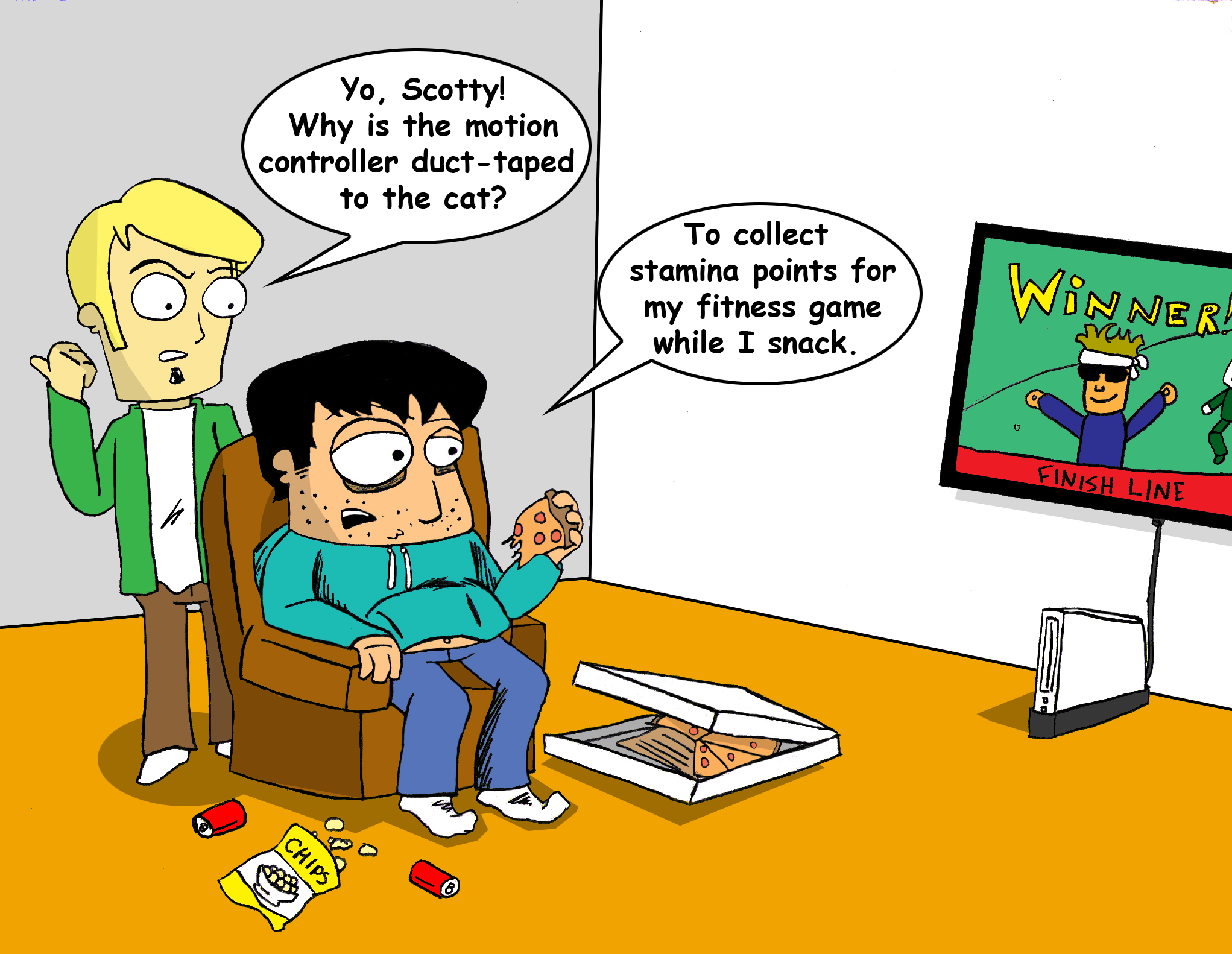
Illustration by Devin Beauregard


New study shows correlation between video games and weight gain

Chaput and his collaborators invited 22 healthy, normal-weight boys between ages 15 and 19 into the lab. The night before the experiment, the boys were instructed not to eat. They arrived at 7:30 a.m. and were all given the exact same breakfast. At 10:30 a.m., they started playing the soccer game FIFA 09 on an Xbox 360 for one hour. Chaput then gave the participants a huge spaghetti lunch. The leftovers were weighed so that researchers could know how much they ate.

The boys usually ate more after gaming. In fact, they ate an average of 163 calories more. This may not sound like much compared to Health Canada’s recommendation of 2,450 calories daily, but these extra calories can have a long-term impact according to Chaput.

“Weight gain is just a small but chronic energy gap over time. Even a surplus of 50 calories per day on a chronic basis can lead to 10 kilograms of weight gain over 25 years,” he explains.

Chaput also wanted to know why boys eat more, so he took blood samples while they gamed. The samples told Chaput heart rates and blood pressure had gone up, but none of the hormones that trigger hunger were found in the work up.

“It seems that it’s more eating in the absence of hunger. Participants don’t feel [hungrier], but they eat more,” says Chaput.

“It’s not explained by the hormones that trigger hunger, so we think that it’s more related to the mental stress aspect of video gaming.”

Chaput’s findings are less than they would be in an outside setting because his subjects played alone, while kids tend to play with friends and usually eat more with others. Chaput also didn’t allow any eating during gaming and the boys played for only an hour.

Chaput also looked at males for a couple of reasons: First, they didn’t want to complicate things by having physical gender differences and “because there are more boys than girls playing video games,” says Chaput.
“Although I would like to know if it’s the same thing with girls,” he adds.
What are the next steps for Chaput’s research? Besides studying adults and interactive gaming, Chaput’s says his study is a warning and direct action is needed.

“Do we find this same pattern in adults? We don’t know … The next step is with active video gaming,” says Chaput. “Of course, we burn more calories when we’re playing this active gaming … but none of those studies have assessed energy intake.”

Chaput adds, “We need to have a better balance between physical work and mental work. We’re doing too much screen time and not enough physical activity.”

Liquid crystals can be radical

What’s she building in there?

the Fulcrum
Published: Oct 5

The problem

HEY, SCIENCE! WHY haven’t you built me an iPod the size of a single cell yet? I’m waiting.
Currently electronics are built out of bulk materials and have inherent size limitations: A wire can only be carved so small if it’s made from an everyday chunk of copper. But imagine if electronic components could be made from large molecules or organics instead of bulky metals.
One day, organic components might be smaller, cheaper, and even easier to fabricate than traditional wires. Sure, it sounds like a great idea, but is it possible?

The researcher

Alicea Leitch doesn’t know either, but she’s trying to find out. Leitch is a post-doctoral researcher in the chemistry department at the University of Ottawa who likes to work on projects that have concrete applications.
Before she arrived at the University of Ottawa, Leitch had already started working on highly reactive chemical substances called radicals.

The project

Radicals can be extremely reactive because they have an unpaired electron, which is just dying to find its soulmate. It’s not exactly picky—radicals will react with just about anything. However, when they are stabilized, the unpaired electron can become very valuable. Sometimes radicals can help carry charges, making otherwise non-conductive materials more interesting.
This makes radicals tempting for molecular electronics. Unfortunately, chemical stabilization almost always vetoes the properties of interest.

The key

To control the radicals without loosing the conductivity, Leitch doesn’t bother with chemical stabilization. Instead, she attaches the radicals to microscopic discs so the previously troublesome unpaired electron doesn’t belong to a single atom. It becomes shared between all the atoms that make up the disc, making it less reactive but still conductive.
On top of that, using discs has unexpected bonuses: They float in liquid and they like to stack in an orderly fashion, like a crystal. This makes them a liquid crystal. If Leitch can get the liquid crystals just right, the discs will automatically assemble into tiny chains.
This natural stacking is great because the structure of molecular electronic components plays a really important role, but is usually hard to control. Because they are stacked together, the single electron can jump from plate to plate, and eventually make its way from one end of the chain to the other.
Together, the conductivity of the unpaired electron and the discs’ self-assembly into long, flexible chains could make Leitch’s liquid crystals into pretty radical wires.

Chemistry as art

What’s she building in there?

the Fulcrum
Published: Sept 9

The problem

UNLIKE MEDIEVAL ALCHEMISTS, who only dreamt of turning lead to gold, modern chemists are experts at reshaping matter. They can produce many molecules, but the process is often wasteful and time consuming. On the other hand, Mother Nature is much more efficient at the task, proving that chemists still have a lot to learn.
Biological processes use enzymes to create specific chemical reactions with little waste and extreme precision. When compounds react to form new chemicals, they must overcome an interaction barrier keeping them separate substances. Enzymes are the tools that these systems use to lower interaction barriers so that a reaction can occur, and new compounds can be created. Enzymes accomplish this by temporarily tethering the reactants together and orienting them so that they approach each other in the best possible way, rather than just randomly reacting.

The researcher

Melissa Macdonald is a PhD candidate in André M. Beauchemin’s lab at the U of O, who knows that if chemists can learn to control and create their own enzymes, many reactions could be recreated more efficiently. In Macdonald’s eyes, chemistry can be an elegant art and not just a series of random reactions.

The project

One reaction in particular stands out for Macdonald: Worthless alkynes can become valuable amines by adding a nitrogen-hydrogen bond. Since amines are a common active ingredient in pharmaceuticals, it is shocking that this seemingly simple transformation is so difficult to reproduce. The usual process involves heating the reactants to extremely high temperatures and using metallic catalysts to lower the interaction barrier. It’s exactly the sort of problem that requires a more elegant, artistic strategy.

The key

By designing an organic catalyst that uses the same tethering method as enzymes, Macdonald tackled this notoriously difficult transformation. The tethering molecule directed the approach of the reactants so intelligently that the interaction barrier was reduced and the reaction could occur at room temperature without the help of toxic metal catalysts.

Membrane madness

What’s he building in there?

The problem
ONE IMPORTANT STEP in water treatment is filtration. Nobody wants little gritty pieces of dreg or oily bits of gunk in their drinking water. River water is passed through membranes in water treatment plants which block oversized contaminants from going any farther. Making membranes with large surface areas, but with small enough pores (micro- or nanofiltration), is possible by casting polymers into a film. These films are either hydrophilic (water-loving) or hydrophobic (water-hating).
It turns out that most contaminants are oily, hydrophobic gook, and since “the enemy of my enemy is my friend” the contaminants are very likely to bury themselves in the hydrophobic membrane to hide from the water. They can’t get through at first, but eventually contamination degradates the membrane’s performance.
On the other hand, hydrophilic membranes have their own set of problems. The contaminants don’t like the membrane, don’t bury themselves in it, and so degradation is slower. But hydrophilic membranes tend to be significantly weaker than hydrophobic ones, and so will often break during water treatment.

The researcher
Takeshi Matsuura is a chemical engineer at the University of Ottawa who develops modified membranes that can improve the distillation and filtration processes. In particular, he is interested in modifying surfaces using large macromolecules that can be attached to membranes.

The project
Filtration science would really benefit from filters that are strong, and that do not rapidly degrade. Hydrophobic and hydrophilic membranes each have their drawbacks, but by combining them, Matsuura hopes that he can get the best of both worlds.

The key
While other scientists cast a strong hydrophobic membrane, and later modify it by grafting hydrophilic polymers on top to make a protective coating, Matsuura thinks this is too slow (and costly). He mixes the hydrophilic and hydrophobic polymers together in solution and then casts them. As the water evaporates, the polymers naturally separate. Matsuura is left with a single membrane with a strong bottom layer and protective coating on top. In just one step, he gets a surface modified film that has the strength of a hydrophobic filter, but degrades slowly like a hydrophilic filter. That really is the best of both worlds.